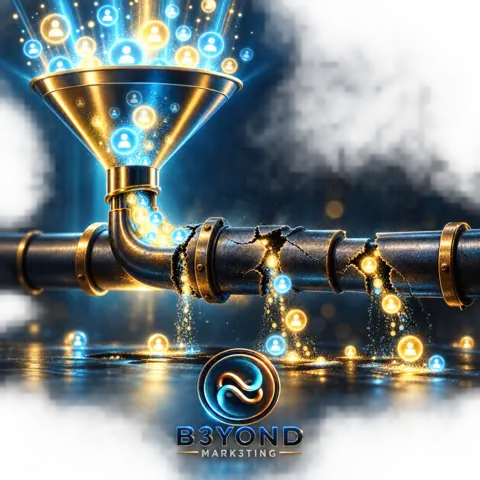
When business is slow, “we need more marketing” sounds like the obvious diagnosis. You may decide to post more often, increase your advertising budget, redesign a flyer, or try another platform. Sometimes that creates a temporary lift. Then the same problem returns.
That is often because marketing was asked to solve a problem that did not begin with marketing.
Marketing can create attention. It can introduce people to your business and give them a reason to become curious. But attention is only the beginning of the customer journey. If inquiries are answered slowly, the website is confusing, follow-up is inconsistent, or the customer experience does not support the promise, adding more attention simply sends more people into a system that is already losing them.
Look Beyond the Number of Leads
Before deciding that you need more leads, look at what happens to the leads you already receive.
- How quickly does someone receive a response after contacting you?
- Is the next step clear?
- Are inquiries recorded in one reliable place?
- Does anyone follow up when a prospect is interested but not ready?
- Can you tell which inquiries become customers and which disappear?
If those questions are difficult to answer, lead volume may not be the central issue. The deeper issue may be lead handling.
Imagine a business receiving 40 inquiries in a month and converting four. It may conclude that it needs 80 inquiries to gain eight customers. But if a better response and follow-up process raised the conversion rate, the business could grow without doubling its advertising cost.
Marketing Reveals the Strength of the System
More attention amplifies what is already present. A clear offer becomes more visible. A strong customer experience creates more referrals. A confusing process produces more confusion. A weak follow-up system loses prospects faster.
This is why successful marketing should not be separated from operations. The advertisement, landing page, contact form, response message, sales conversation, service delivery, and follow-up are parts of one experience. Customers do not experience your departments or software. They experience the journey as a whole.
If one part breaks, the whole journey feels unreliable.
Diagnose Before You Increase the Budget
Start with a simple review of the path a customer takes:
- Discovery: Where do people first encounter the business?
- Understanding: Can they quickly understand what you do and who you help?
- Action: Is there one clear next step?
- Response: What happens immediately after they take that step?
- Decision: How are questions, objections, and delays handled?
- Experience: Does the service fulfill the expectation created by the marketing?
- Continuation: Is there a process for reviews, referrals, repeat business, or re-engagement?
This review often reveals that the visible marketing problem is connected to something else: unclear positioning, a slow response process, scattered customer information, or no retention strategy.
Fix the Most Expensive Leak First
You do not need to rebuild everything at once. Identify the point where the most opportunities are being lost.
If people see your content but do not contact you, clarify the message and call to action. If they contact you but do not receive a timely response, improve the intake process. If they buy once but never return, build a customer retention system. If referrals happen randomly, create a consistent way to ask for them.
The best next investment is the one that strengthens the weakest important part of the journey.
Marketing Works Better When the Business Works Together
You may still need more visibility, more content, or paid advertising. The point is not to avoid marketing. It is to make sure marketing is connected to the business it is supposed to grow.
Before asking, “How do we reach more people?” ask, “What happens when people reach us?”
That question can save money, reveal hidden opportunities, and turn marketing from a collection of activities into a system that supports growth.
B3YOND perspective: If your business is getting attention but not enough results, the problem may be hiding between the first click and the final decision. B3YOND helps businesses examine that entire journey, connect the missing pieces, and build a system that works more intelligently. Book a consultation to explore where your opportunities may be getting lost.