Introduction
Buying AI tools is easy. Building an AI ecosystem is harder—and far more valuable. A business can subscribe to a chatbot, an image generator, an automation platform, a customer relationship manager, and a dozen specialized applications without becoming meaningfully more intelligent. If those tools do not share a purpose, use reliable information, fit existing workflows, or lead to accountable action, the result is usually more complexity rather than more capability.
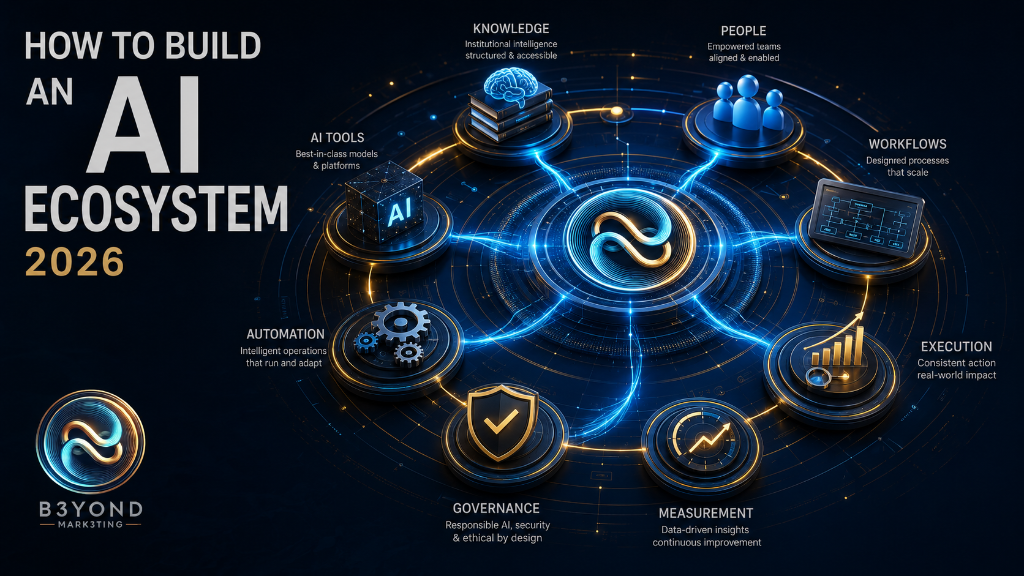
An AI ecosystem is a coordinated operating environment in which people, information, AI tools, and business systems have clearly defined roles. One layer may research current information. Another may organize the company’s approved knowledge. A general AI assistant may help interpret, draft, and plan. Creative tools may turn approved ideas into visual or video assets. Automation may move information between systems. Human owners remain responsible for judgment, approval, relationships, and consequences.
This distinction matters because businesses do not create value by possessing software. They create value by performing work: answering customers, solving problems, producing deliverables, making decisions, following up, serving clients, and learning from results. The ecosystem should make that work faster, clearer, more consistent, or more scalable. If it does not, it is merely a collection of subscriptions.
B3YOND principle: Most businesses do not need more AI tools. They need the right AI ecosystem. |
What an AI Ecosystem Actually Includes
A useful ecosystem contains more than applications. It has six connected elements, each of which must be designed deliberately.
- Business outcomes: the measurable result the organization wants, such as faster proposals, better lead follow-up, more consistent content, fewer missed tasks, or clearer decisions.
- Workflows: the repeatable sequence through which work enters, changes hands, receives approval, and produces an outcome.
- Information: the policies, brand standards, customer data, source material, templates, records, and context required to perform the work correctly.
- Intelligence tools: the AI systems used to research, reason, summarize, draft, classify, generate, or recommend.
- Execution systems: the platforms that publish, store, schedule, notify, transact, or track the work after intelligence has been applied.
- Human governance: the owners, permissions, review standards, escalation rules, and accountability that keep the system useful and safe.
These elements form a loop. A business objective defines the workflow. The workflow determines what information is needed. The information helps identify the right tools. The tools support execution. People review the result. Performance data then improves the next cycle. Building the ecosystem means designing that loop—not merely selecting popular products.
The Seven Layers of a Practical AI Ecosystem
Not every business needs a separate platform for every layer. A single tool may serve several roles, especially at the beginning. The important point is to define responsibilities so that information and work move intentionally.
1. Research and discovery
This layer finds current public information, sources, market signals, competitor positioning, regulations, customer questions, and evidence. Search engines and answer engines such as Perplexity can accelerate discovery, but their outputs must still be checked against primary sources. Research should feed decisions; it should not become an endless collection of links.
2. Knowledge and context
This layer contains the information the business already trusts: brand guidelines, service descriptions, approved claims, operating procedures, pricing rules, templates, training material, and reference documents. Source-grounded systems such as NotebookLM can help teams question and summarize approved materials. A well-maintained knowledge layer reduces repeated explanations and keeps AI outputs closer to the organization’s actual reality.
3. Intelligence and coordination
A general assistant such as ChatGPT or Claude can function as the thinking workspace. It can convert research and business context into plans, drafts, analyses, checklists, decisions, and instructions for other systems. Its value increases when the team gives it defined goals, relevant context, examples, constraints, and a clear review standard. The assistant should coordinate work, not pretend to be the final authority on every subject.
4. Creation and production
This layer turns approved ideas into market-ready assets. Canva may support graphics and presentations; Adobe tools may handle advanced image and video work; Descript or similar platforms may support recorded content. The workflow should separate message approval from visual production so a polished design cannot conceal an inaccurate claim or weak strategy.
5. Automation and agents
Automation platforms such as Zapier, Make, n8n, or agent systems can move data, trigger tasks, notify staff, create records, and coordinate multi-step routines. Automation belongs after a workflow is understood. Automating confusion simply allows errors to occur faster and at greater scale. Every automated process needs a clear trigger, data boundary, failure path, owner, and recovery method.
6. Business systems and execution
This is where the work becomes operational: the CRM, website, email platform, calendar, project manager, accounting system, customer portal, or custom application. Base44 and other app-building platforms can help create specialized operational tools when ordinary software does not fit. AI should connect to the systems where work is completed and measured, not live in an isolated chat window.
7. Measurement and improvement
The final layer answers a simple question: did the ecosystem improve the business? Track a small set of operational measures such as turnaround time, response rate, conversion, rework, missed handoffs, cost per deliverable, customer satisfaction, or hours saved. Measurement creates a feedback loop that reveals which prompts, sources, tools, and automations deserve to stay.
How to Build Your AI Ecosystem: A Nine-Step Framework
Step 1: Start with a business outcome
Choose one concrete outcome rather than a broad ambition to “use AI.” A strong starting point might be reducing proposal preparation from three hours to one, responding to qualified inquiries within fifteen minutes during business hours, producing a weekly content package from one approved idea, or turning meeting notes into assigned tasks before the day ends. The outcome creates a boundary for the project and a basis for measuring value.
Write the current baseline, desired result, owner, deadline, and quality requirement. If the team cannot define what better looks like, it cannot judge whether AI helped.
Step 2: Map the current workflow
Document how the work happens now from trigger to completion. Identify every handoff, system, decision, delay, repeated entry, and approval. Include the unofficial steps employees perform from memory, because these often contain the most important context. Then mark which parts require creativity, judgment, sensitive information, customer interaction, or regulatory care.
The map usually reveals that the tool is not the first problem. Missing templates, inconsistent intake, unclear ownership, scattered files, and unnecessary approvals often create more friction than the task itself.
Step 3: Classify the information
List the information the workflow uses and classify it before placing anything in an AI system. A simple model is public, internal, confidential, and regulated. Public information may include published service descriptions or market research. Internal information may include SOPs and ordinary planning documents. Confidential information may include financial details, customer lists, contracts, or proprietary strategy. Regulated information may include health, financial, employment, or other protected records.
For each category, decide where it may be stored, who may access it, whether it may be used by AI, what configuration is required, and when it must be removed or anonymized. Do not assume that a familiar consumer tool is approved for every type of data.
Step 4: Assign one primary role to each tool
Select the smallest practical stack and give each product a primary job. For example: Perplexity researches; NotebookLM grounds answers in approved sources; ChatGPT coordinates and drafts; Canva designs; HubSpot tracks leads; Zapier moves approved non-sensitive data; Base44 supports a custom operations dashboard. A tool may have secondary uses, but its main role should be easy for the team to explain.
Role clarity prevents duplicate work, contradictory records, and the common habit of buying a new platform whenever an existing one is misunderstood.
Step 5: Design the handoffs
Specify what moves from one layer to the next. A research brief may become an approved content outline. The outline may become draft copy. Approved copy may become a visual asset. The published asset may create leads in the CRM. Lead status may trigger a follow-up task. Campaign results may return to the intelligence workspace for review.
Every handoff should identify the input, expected output, format, responsible owner, approval point, storage location, and exception path. This is the difference between an ecosystem and a loose collection of clever demonstrations.
Step 6: Build reusable context
Create a compact source package for the workflow: goals, audience, brand voice, services, rules, examples, definitions, templates, prohibited claims, and acceptance criteria. Keep the authoritative version in a controlled location and update it when the business changes. Reusable context allows employees to start from organizational knowledge instead of rebuilding instructions in every conversation.
Good context is specific without becoming cluttered. Include what changes the result. Remove outdated material, duplicate instructions, and vague slogans that do not guide a decision.
Step 7: Insert human approval where consequences rise
Human review should become stronger as risk increases. A low-risk internal brainstorm may need a quick reasonableness check. Public marketing needs brand and factual review. A financial recommendation, legal statement, clinical communication, hiring decision, or customer promise requires qualified oversight and clear accountability.
Define what AI may draft, what it may recommend, what it may execute automatically, and what it must never do without approval. The goal is not to place a human after every keystroke; it is to preserve human responsibility at consequential decisions.
Step 8: Pilot one complete workflow
Test the entire loop with real but appropriately controlled work. Run enough examples to expose edge cases, poor inputs, tool failures, ambiguous ownership, and inconsistent output. Compare the new workflow with the baseline. Ask the people performing the work whether the system actually reduces effort or merely moves it elsewhere.
A successful pilot produces a repeatable process, not one impressive result. Document the final steps, prompts, templates, access rules, and recovery procedures before expanding.
Step 9: Measure, simplify, and scale
Review performance on a regular schedule. Keep tools that improve the target outcome. Change context or workflow design when quality is inconsistent. Remove integrations that rarely create value. Expand only after the first workflow is stable, then reuse the same architecture for an adjacent process.
Scaling an ecosystem should increase organizational learning. Each successful workflow adds trusted context, patterns, and governance that make the next workflow easier to build.
A Small-Business Ecosystem Example
Consider a service business that wants to turn expertise into consistent marketing and qualified consultations without hiring a large internal team.
- Research: Perplexity identifies current customer questions, credible sources, and local market signals.
- Knowledge: NotebookLM holds approved service information, brand documents, FAQs, and reference material.
- Intelligence: ChatGPT converts the evidence and business context into a monthly strategy, article outlines, campaign messages, and production briefs.
- Creation: Canva produces branded graphics while Descript turns one recorded explanation into long-form and short-form video assets.
- Execution: The website publishes the article and captures consultation inquiries; HubSpot records approved lead information and pipeline status.
- Automation: Zapier or Make sends internal notifications, creates follow-up tasks, and updates non-sensitive campaign records.
- Measurement: The team reviews response time, booked consultations, content performance, and production hours each month.
The power is not in any single tool. It is in the designed movement from evidence to knowledge, from knowledge to intelligence, from intelligence to production, and from production to measurable business action.
Common Mistakes to Avoid
Buying before mapping
Tool-first adoption creates subscriptions in search of a problem. Map the outcome and workflow before choosing the platform.
Letting every tool do everything
Overlapping roles produce duplicate sources of truth and uncertain ownership. Give each tool a primary responsibility and retire unnecessary duplication.
Confusing output with completion
A generated draft is not a finished business result. Completion may require verification, approval, design, publication, customer follow-up, recordkeeping, and measurement.
Ignoring information governance
Convenience does not eliminate privacy, security, contractual, or regulatory duties. Classify information and approve each tool-data combination deliberately.
Automating an unstable process
If the manual workflow changes every week, automation will encode uncertainty. Standardize the process and exception handling first.
Keeping no owner
An ecosystem without ownership decays. Assign someone to maintain sources, permissions, integrations, performance measures, and workflow documentation.
Measuring activity instead of value
More prompts, assets, or automations do not necessarily improve the business. Measure outcomes such as time, quality, response, revenue, satisfaction, and avoided errors.
Governance Checklist
- Purpose: Is the workflow tied to a defined business outcome and owner?
- Data: Has every information type been classified, minimized, and approved for the selected system?
- Access: Do people and integrations have only the permissions required for their role?
- Quality: Are sources, examples, acceptance criteria, and review standards documented?
- Approval: Is human oversight proportional to the consequence of an error?
- Automation: Are triggers, logs, failure alerts, retries, and recovery procedures defined?
- Security: Are vendor terms, retention, training use, authentication, and account controls understood?
- Continuity: Can the business continue if a tool fails, changes price, or becomes unavailable?
- Measurement: Does the team review a small set of outcome metrics on a fixed schedule?
B3YOND Insight
The most important design decision is not which AI model ranks first. It is where intelligence belongs inside the business. AI becomes strategically useful when it can access the right approved context, assist the right workflow, hand work to the right system, and stop at the right human decision.
That is why B3YOND approaches AI as ecosystem building. The objective is not to surround a company with technology. It is to help the company think and operate intelligently. Sometimes that requires a new tool. Often it requires clearer information, better workflow design, stronger handoffs, and disciplined use of tools the company already has.
B3YOND Verdict
Build from the outcome backward. Start with one workflow, one accountable owner, one approved source of context, and the smallest set of tools capable of completing the loop. Define roles before integrations. Establish information boundaries before automation. Measure the business result before expanding.
A mature AI ecosystem does not feel like a pile of software. It feels like a coherent operating system: evidence enters, organizational knowledge gives it meaning, intelligence helps transform it, people apply judgment, systems execute, and results make the next decision better.
Related Tools
- ChatGPT — general intelligence, planning, drafting, and workflow coordination
- Claude — long-form reasoning, analysis, and document-centered work
- Perplexity — current research and source discovery
- NotebookLM — source-grounded knowledge and learning
- Canva — branded visual production
- Zapier, Make, or n8n — workflow automation
- Base44 — custom business applications and operational systems
Related Stack
B3YOND Small Business AI Ecosystem: Research → Knowledge → Intelligence → Creation → Automation → Execution → Measurement.
Build the Right Ecosystem for Your Business
Every organization has different workflows, information boundaries, customers, and growth priorities. B3YOND MARK3TING helps businesses identify where AI can create practical value, choose the right tools, design responsible workflows, and connect them into an ecosystem that supports real operations.
Visit b3yondmark3ting.com to explore the AI Directory, compare AI stacks, or book a consultation.